Trainability of IQP Quantum Circuit Born Machines Under Gaussian Initialization
- School of Computing and Augmented Intelligence
- Arizona State University
Abstract
Quantum Circuit Born Machines (QCBMs) offer a natural approach to generative machine learning by leveraging the Born rule. Recent work demonstrates that QCBMs instantiated with Instantaneous Quantum Polynomial (IQP) circuits can be trained entirely classically via the Maximum Mean Discrepancy (MMD) loss. However, trainability remains constrained due to exponential concentration and barren plateaus. In this work, we leverage Stein’s lemma and Lipschitz concentration bounds to establish a rigorous trainability framework for IQP-QCBMs initialized under Gaussian parameters \(\theta_j \sim \mathcal{N}(\mu_\theta, \sigma_\theta^2)\). We derive an analytical lower bound on gradient variance governed by \(\exp(-2\sigma_\theta^2 \lvert\Gamma(a)\rvert)\), showing that concentration depends on parameter-observable overlap counts \(\Gamma(a) := \{j : g_j \cdot a = 1\}\) rather than geometric locality assumptions or circuit depth alone. We also show that scaling parameter initialization variance as \(\sigma_\theta^2 = \mathcal{O}(1 / \max_a \lvert\Gamma(a)\rvert)\), mean as \(\mu_\theta = \mathcal{O}(1 / \sqrt{\max_a \lvert\Gamma(a)\rvert})\), and MMD kernel bandwidth as \(\sigma = \Omega(n)\) mitigates exponential concentration and prevents barren plateaus. Finally, we derive a probabilistic concentration bound on gradient deviations showing the conditions under which barren plateaus are likely to happen.
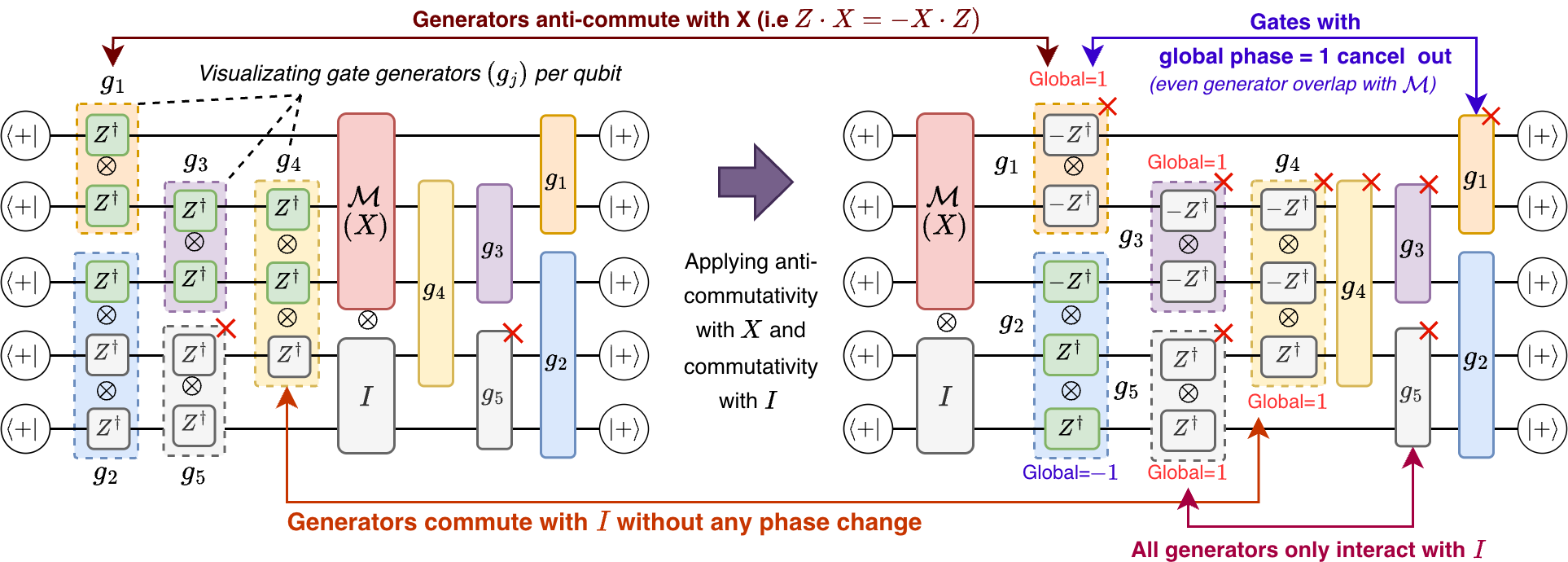
Important Figures
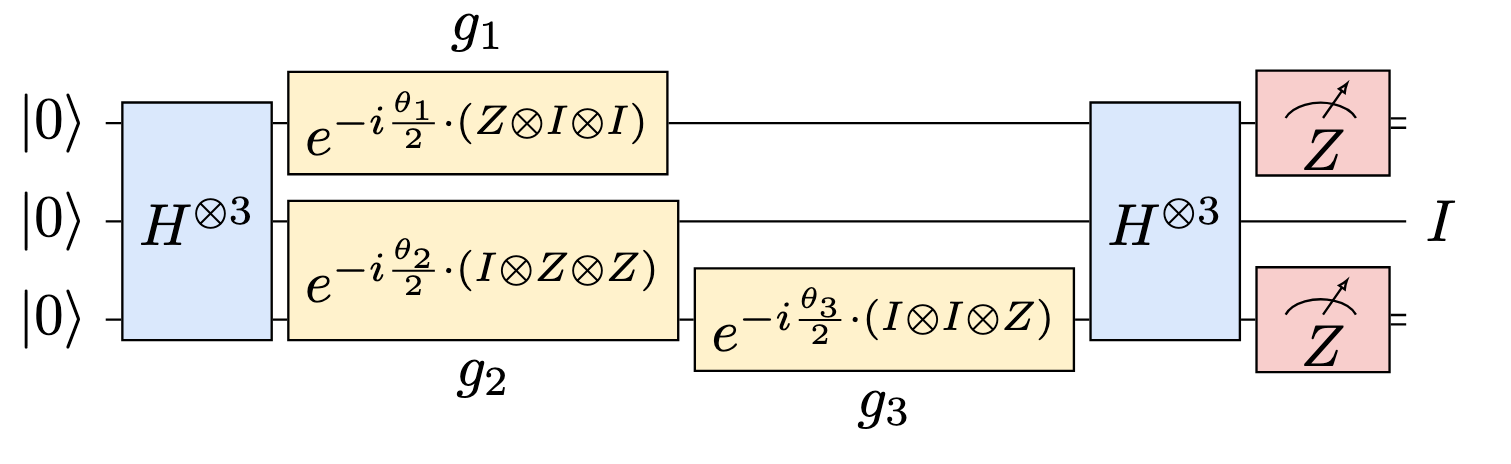
IQP QCBM with the generator strings gj = [1,0,0], [0, 1, 1], [0, 0, 1], and measurement configuration a = [101]
Paper Details
Quantum Circuit Born Machines (QCBMs) offer a promising framework for generative quantum machine learning, leveraging the Born rule to define probability distributions through quantum state measurements (Liu and Wang 2018; Coyle et al. 2020; Gili et al. 2023). When instanti- ated with Instantaneous Quantum Polynomial (IQP) circuits (Bremner, Montanaro, and Shepherd 2016), QCBMs exhibit a powerful duality. Sampling from these circuits is prov- ably hard for classical computers under standard complexity assumptions (Bremner, Montanaro, and Shepherd 2016), yet their Pauli expectation values can be calculated classi- cally in polynomial time (Nest 2009). By reformulating the Maximum Mean Discrepancy (MMD) loss (Liu and Wang 2018) strictly in terms of these analytical expectation values, IQP-QCBMs can be optimized entirely classically (Recio- Armengol, Ahmed, and Bowles 2025). This “train classically, deploy quantumly” paradigm avoids shot noise from quantum measurement and physical device errors during optimization, allowing models to be trained classically prior to deploying quantum sampling at scale, making them exceptionally hardware-efficient and attractive for NISQ-era applications (Recio-Armengol, Ahmed, and Bowles 2025).
Despite these practical advantages, the optimization of quantum machine learning models remains severely constrained by trainability bottlenecks. Chief among these is the phenomenon of barren plateaus (McClean et al. 2018), where the variance of cost function gradients vanishes exponentially with the increase in the number of qubits, leaving optimization algorithms stranded on flat cost landscapes. In loss formulations such as the MMD, this issue is intimately linked to kernel concentration (Thanasilp et al. 2024), where parameter updates become exponentially concentrated around their mean value, rendering the loss landscape uninformative and data-independent. Critically, these issues are inherent to the quantum feature space and therefore also plague classically trained IQP-QCBMs even in the absence of noise.
To address the trainability challenges in the classically trained IQP-QCBMs, recent work (Lerch et al. 2026) explored mitigation strategies like warm starts and data-dependent initializations, but their framework remains tied to uniform hypercube sampling. Beyond that, (Shen et al. 2026) analyzed trainability under uniform initialization (\(\theta_j\sim U[0,2\pi]\)). However, uniform sampling of parameters across \([0,2\pi]\) forces quantum states to globally over-explore Hilbertspace, causing destructive phase interference that guarantees exponential gradient decay (barren plateaus) as system size grows. As such it is useful to expand this analysis to other parameter initialization schemes.
As noted by (Shen et al. 2026) themselves, that small- variance Gaussian initialization (\(\theta_j\sim N(\mu_\theta,\sigma_\theta^2)\) may hold significant promise in addressing the trainability of IQP-QCBMs. Analogous to variance-scaled initializations like Xavier (Glorot and Bengio 2010) or He (He et al. 2015) in classical deep learning, tuning \(\sigma_\theta^2\) controls how quantum states explore Hilbert space—restricting trajectories to informative local sub-regions to prevent exponential concentration (Zhang et al. 2022). However, their Gaussian analysis relies on global worst-case assumptions, yielding loose bounds that miss how initialization variance \(\sigma_\theta^2\) interacts with local gate coupling and phase cancellations.
This work extends the analysis of trainability of IQP-QCBMs under Gaussian parameter initialization and establishes a rigorous theoretical framework for IQP-QCBM trainability under Gaussian initializations. By leveraging Stein’s lemma and Lipschitz concentration inequalities, our theoretical analysis establishes analytical lower bounds on MMD gradient variance and probabilistic concentration for IQP-QCBMs under Gaussian initializations. The main results of this paper are:
-
We derive an analytical closed-form expression for the MMD cost gradient, demonstrating that non-zero updates occur strictly for observables \(Z_a\) that overlap with a parameter’s generator mask (\(\mathbf{g}_k \cdot \mathbf{a} = 1\)). Consequently, sparse IQP generators inherently induce a sparse gradient structure.
-
We establish an analytical lower bound on loss gradient variance showing gate cancellations restrict observable dependencies to a local reverse light cone, \(\Gamma(a) := \{j : \mathbf{g}_j \cdot \mathbf{a} = 1\}\). Thus, gradient variance decays as \(\exp(-2\sigma_\theta^2 \lvert\Gamma(a)\rvert)\), showing that local gate connectivity – rather than total circuit depth – determines whether an IQP circuit concentrates.
-
We prove that exponential gradient concentration is strictly mitigated when the parameter initialization variance scales as \(\sigma_\theta^2 = O(1/ \max_a \lvert\Gamma(a)\rvert)\), the parameter mean scales as \(\mu_\theta = O(1/ \sqrt{\max_a \lvert\Gamma(a)\rvert})\), and the MMD kernel bandwidth scales as \(\sigma = \Omega(n)\). Consequently, tuning initialization variance to the local reverse light cone size preserves trainability across arbitrary IQP circuit structures.
-
We establish a Gaussian concentration bound for MMD cost gradients, showing that deviation probabilities are controlled by the product of the parameter variance and the Lipschitz constant of the gradient of the loss. This bound shows that a small variance and dense circuit can both diagnose the occurrence of a barren plateau.
Bibtex
@misc{deluca2026trainabilityiqpquantumcircuit,
      title={Trainability of IQP Quantum Circuit Born Machines Under Gaussian Initialization},
      author={Gennaro De Luca, Vinayak Sharma, Aviral Shrivastava},
      year={2026},
      eprint={2606.10179},
      archivePrefix={arXiv},
      primaryClass={quant-ph},
      url={https://arxiv.org/abs/2606.10179},
}